
Freising Diocesan Museum: Art and Culture on the Domberg
The Freising Diocesan Museum (DIMU) is one of the world’s largest museums of religious history. Situated on Freising’s Cathedral Hill, it brings together masterpieces spanning two millennia with international contemporary art and a programme of temporary exhibitions. A centre for art and culture that surprises visitors with extraordinary works and fresh perspectives.
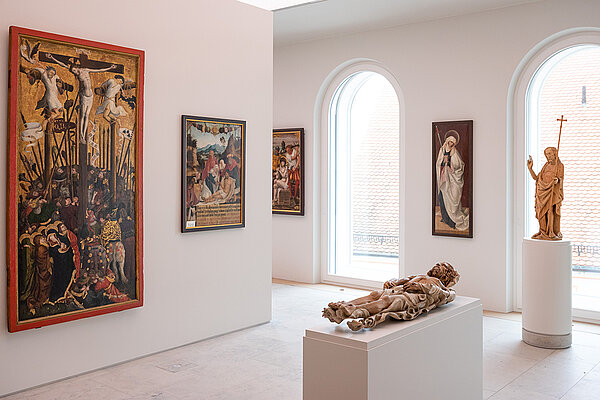
Masterpieces spanning two millennia
The Diocesan Museum’s collection comprises around 50,000 items. The permanent exhibition showcases Christian art from late antiquity to the present day. On display are, amongst others, works by Lucas Cranach, Ignaz Günther, the Asam brothers and other significant masters of the Gothic, Baroque and Rococo periods.
Its own section, ‘2,972 Objects: Byzantium in Freising’, is dedicated to early Christian and Byzantine art and culture.


James Turrell: Light Art as a Spatial Experience
One of the museum’s highlights is the light installation ‘A CHAPEL FOR LUKE and his scribe Lucius the Cyrene’ by the American artist James Turrell. In the former private chapel, light, colour and space merge to create a fascinating experience. This completely throws our usual perception of space off balance.
Opening times for the Turrell installation: The installation is open on the museum’s opening days (Tuesday to Sunday) from 10.00 am to 11.30 am and from 2.30 pm to 4.00 pm. Due to high visitor numbers, please allow for longer waiting times if necessary.
#TURRELLANDYOU: The light space can be booked exclusively for individuals or groups for 30 minutes (50 euros). Enquiries and bookings at kunstvermittlung@dimu-freising.de.
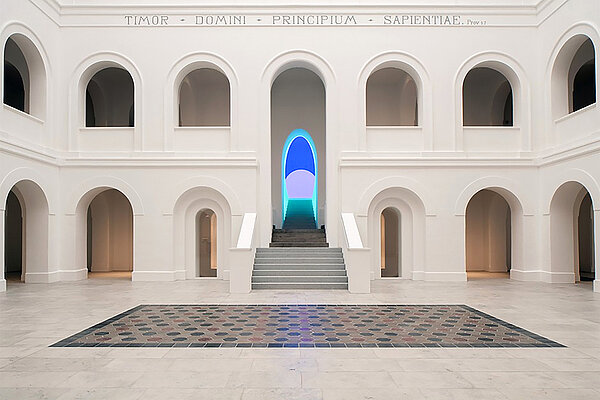
International contemporary art in and around the museum
Internationally renowned artists also leave their mark on the Diocesan Museum and its surroundings:
- Berlinde De Bruyckere: The monumental bronze sculpture ‘ARCANGELO’ makes a striking impression in the museum’s atrium.
- Kiki Smith: ‘Mary’s Mantle Chapel’ on the west terrace is an artistically designed chapel space that invites visitors to pause and reflect.
- Anselm Kiefer: His striking female figures ‘Sappho’, ‘Ave Maria Turris Eburnea’ and ‘Maria Mater Dolorosa’ can be viewed at any time on the Domberg.
- Michael Wesely: His photographic works document the museum’s transformation in an unusual way.


Current Special Exhibitions
With its changing special exhibitions, the Diocesan Museum is constantly introducing new highlights. International art, unusual themes and fresh perspectives make it well worth a return visit.
Discover current exhibitions: Our recommendations (in German only)
Freising Diocesan Museum
Contact
Diözesanmuseum Freising
Domberg 21
85354 Freising
General enquiries:
Phone +49 89 2137 74240
Mail info@dimu-freising.de
Booking enquiries:
Phone +49 89 2137 74369 (Tuesday to Thursday 9 to 11 a.m.)
Mail kunstvermittlung@dimu-freising.de
Web https://www.dimu-freising.de
Opening hours
Tuesday to Sunday from 9 am to 5 pm
During the run of the exhibition “S.O.S. – Save our Souls!” – that is, from 20 October 2026 to 4 April 2027 – the museum will have extended opening hours on Thursdays: instead of 5 pm to 8 pm
Admission prices
You can find an overview of the various admission prices on the museum's website (German only).
Barrier-free
The entire museum is either step-free or accessible via lifts. Further information on accessibility and a building plan are available on the museum's website (currently available in German only).
You can get to the Diözesanmuseum with the Dombergbahn. This connects the city centre from Bahnhofstraße with the Domberg without barriers and is located directly on the corner of Bahnhofstraße and Brunnhausgasse. Further information here on the website.
Parking
The parking garage on the Domberg is available. Access by bus is not possible. Please check our website for information about parking and bus stops.
Exhibitions
Information on current exhibitions at https://www.dimu-freising.de/ausstellungen/aktuell (currently available in German only).
Programme
Flyer for the programme from October to December 2026 (in German only)
Flyer for the programme from January to March 2027 (in German only)